
How To Blend Traditional Middle East Aesthetics With Modern Interior Design In Dubai
By Raj Khaneja · Founder & CEO
Blending traditional Middle East aesthetics with modern interior design in Dubai is a hallmark of the city's cosmopolitan style, creating spaces that honor heritage while celebrating contemporary luxury.
Blending traditional Middle East aesthetics with modern interior design in Dubai is a hallmark of the city's cosmopolitan style, creating spaces that honor heritage while celebrating contemporary luxury. When achieving such a harmonious balance especially for an interior design or an interior decoration company, it is all about mixing the cultural elements like mashrabiya screens, calligraphy art, and the use of rich warm tones with minimalistic styled furniture and the use of the latest lighting technology.
Understanding the Fusion: Dubai's Design Identity
Dubai is known worldwide for its brave and daring approach towards interior design that is a perfect blend between the old traditions and the new innovations. This perfect blend is particularly visible in the residences, offices, and public places that are created by leading interior design companies, who are skillful in striking a balance between the client's desires and the aesthetic that is typical of the city. The top interior design in Dubai is a mix of the Arab legacy and worldwide trends, the works that show the refined lifestyle of a metropolitan citizen.
We provide residential interior design in dubai — designed, built and finished by one in-house team since 1999.
Mashrabiya Screens: Tradition Meets Technology
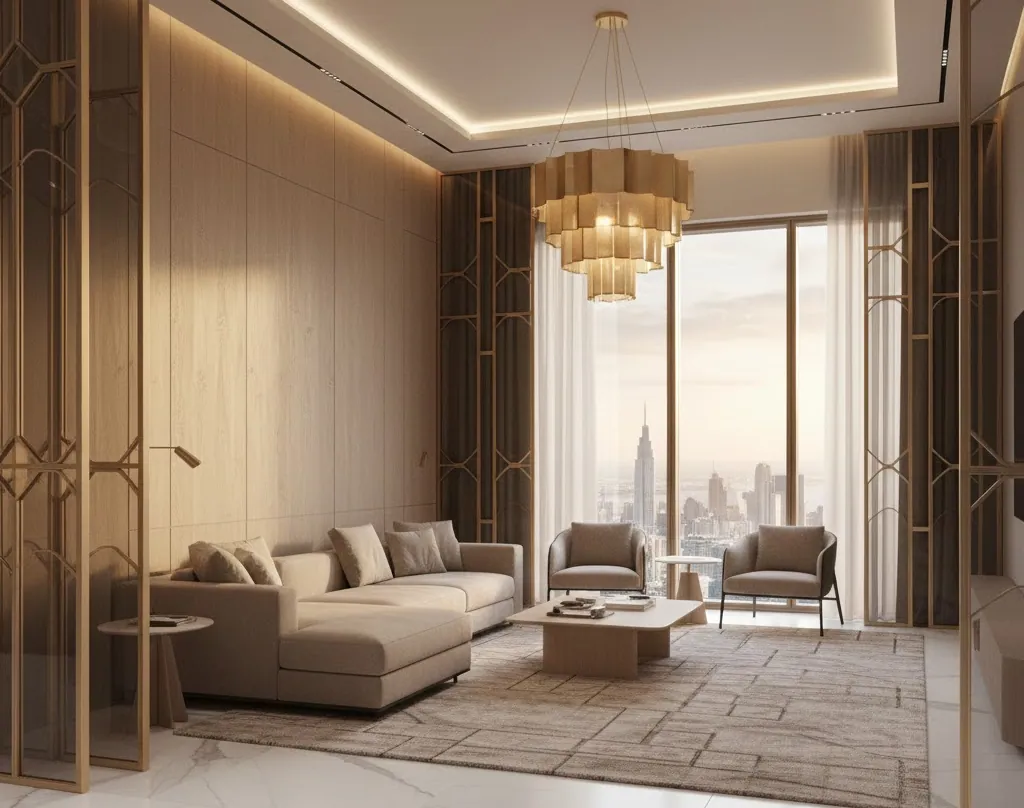
Among the various features of Middle East architecture, Mashrabiya screens are probably the most globally recognized ones. Formerly the intricately carved wooden lattice screens, they were the means for privacy and controlling the light that entered the homes. In modern interior design in Dubai, mashrabiya screens are reimagined with innovative techniques such as parametric modeling, allowing designers to integrate complex geometric patterns into glass partitions, metal panels, and even contemporary furniture. Apart from their use as chic room dividers, the screens may also be there on the walls decorating them or as the accent feature of the cabinet foundations giving the interiors a vibe of both being rooted and current.
Calligraphy Art: Timeless Cultural Expression
Middle East calligraphy has long been revered for its flowing forms and spiritual meaning. For the interior decoration companies in Dubai, calligraphy art is a way of adding the immersion and the identity to the modernized spaces. The designers often do this by commissioning the creation of artwork that has a poetic verse or an inspirational quote and these become the attractive spots over sofas, in the hallways or within the majlis (traditional gathering spaces). Calligraphy, whether in frames, painted straight on walls or incorporated within the soft furnishings, still retains the elegance of an additional cultural layer, which does not overwhelm an area's openness and clean lines.
Warm Tones and Natural Materials
An additional important factor of Middle East-styled apartments is the color scheme that is full of warm earth hues – terracotta, ochre, deep gold, and sandy beige are the colors that summon the landscapes of the region and at the same time, send a strong message of welcome. Interior design companies use these colors alongside the natural materials such as wood, stone, and metal, which are sometimes textured with arabesque or geometric patterns for a higher level of refinement. Modern furniture pieces frequently feature clean silhouettes and neutral tones, serving as a base for colorful art, plush carpets, and statement lighting.
Discover Middle East House Design Ideas →
Sleek Modern Furniture and Lighting
Modern interior design in Dubai derives its character from the presence of exquisite and functional furniture pieces such as streamlined sofas, modular chairs, and minimalist tables that make a stunning contrast with the handcrafted or traditional décor. The role of the lightening design is as important as that of the furniture since it can both bring out the warmth in the Middle East color schemes and at the same time, keep the space looking airy and bright. The interior decoration companies offer various lighting options such as the use of a grand chandelier reminiscent of palace hospitality, along with concealed lights and modern pendant fixtures. The combination of ambient glows with concentrated accent lights provides a space that can be easily changed from a lively area for socializing to a private and quiet retreat.
Creating a Balanced Space: Practical Tips
To successfully blend Middle East elements with modern design, follow these steps:
- Use mashrabiya screens to gain privacy, control the light, and add a decorative touch, however, if you want to make it modern, combine them with glass or metal material.
- Place calligraphy art strategically, ensuring it complements rather than competes with minimalist furniture or architectural features.
- Support warm traditional colors with stylish, neutral-toned furniture that will bring to light instead of hiding cultural textiles and carpets.
- Utilize a mix of lighting types – layering traditional ornate fixtures with modern LED systems for versatility and atmosphere.
- Take advice from a well-known interior design company based in Dubai to confirm your space is not only distinctly personal but also professionally balanced, thus you can get the most out of each and every design choice.
Conclusion
The art of merging the traditional Middle East style with the contemporary interior design in Dubai is basically about the thoughtful integration. The interior design in Dubai keeps on changing but the respect for the past can always be seen in every successful project. By teaming up with a proficient interior design company or an interior decoration company, the homeowners and the businesses will be able to have the spaces that are not only timeless and functional but also strongly linked with both past and present.
Common questions
How do you use traditional detail without it feeling like pastiche?+
Use it structurally rather than decoratively. A screen that genuinely controls light and privacy, a courtyard that actually organises the plan, or a proportion carried through the joinery will read as considered. The same motifs applied as surface pattern on top of an otherwise unrelated interior read as decoration.
Which traditional elements adapt best to a modern apartment?+
Screening, seating arrangements that face inward, and material palettes drawn from stone, plaster and timber. All three work at apartment scale. Courtyards and large majlis arrangements generally do not, though the idea behind them — a room organised around gathering rather than around a television — transfers well.
Does a majlis have to be a separate room?+
Not necessarily, though a separate room is the traditional arrangement and remains the most flexible. Where space does not allow it, the function can be carried by a distinct seating area that can be closed off or screened when needed. What matters is that guests can be received without moving through the family's private space.
This is part of our residential interior design. One team designs and builds it, end to end.
Raj Khaneja — Founder & CEO
Raj founded Rectangle Interiors in 1999 and was named Designer of the Year by Dubai Municipality. He and the team have delivered 1,500+ interiors across Dubai. More about the team →