
From Desert Sands To Modern Luxury: Interior Design Dubai Colour Schemes That Work
By Raj Khaneja · Founder & CEO
Colour schemes that work in Dubai homes start from the new neutrals — sand, stone and plaster tones that hold up against strong light — then add depth with coastal blues and Gulf teals rather than high-contrast accents.
Entering a home in Dubai can be compared to walking into a personal space which is so well-planned architecturally & styling-wise in order to keep the vibrant energy and heat of the city at bay. Of all the different tools that an interior designer can use to strike the right balance between getting a space that is both comfortable and stylish, colour is undeniably the most powerful one. In fact, it goes beyond that, it is first and foremost about establishing a mood that resonates with the local landscape as well as the opulence of the area.
This article delves into the right combination of colours for homes in Dubai. You will be taught how to use the traditional elements with the contemporary ones in order to make the residence appear both eternal and fresh.
We provide residential interior design in dubai — designed, built and finished by one in-house team since 1999.
The Power of the New Neutral
Neutral colour schemes are a necessity in Dubai interior design due to the reason that they reflect sunlight allowing the room to stay cool and look more spacious. A lot of people associate neutral colours with boring, however, the "New Neutral" actually mean mixing different textures and slight tints.
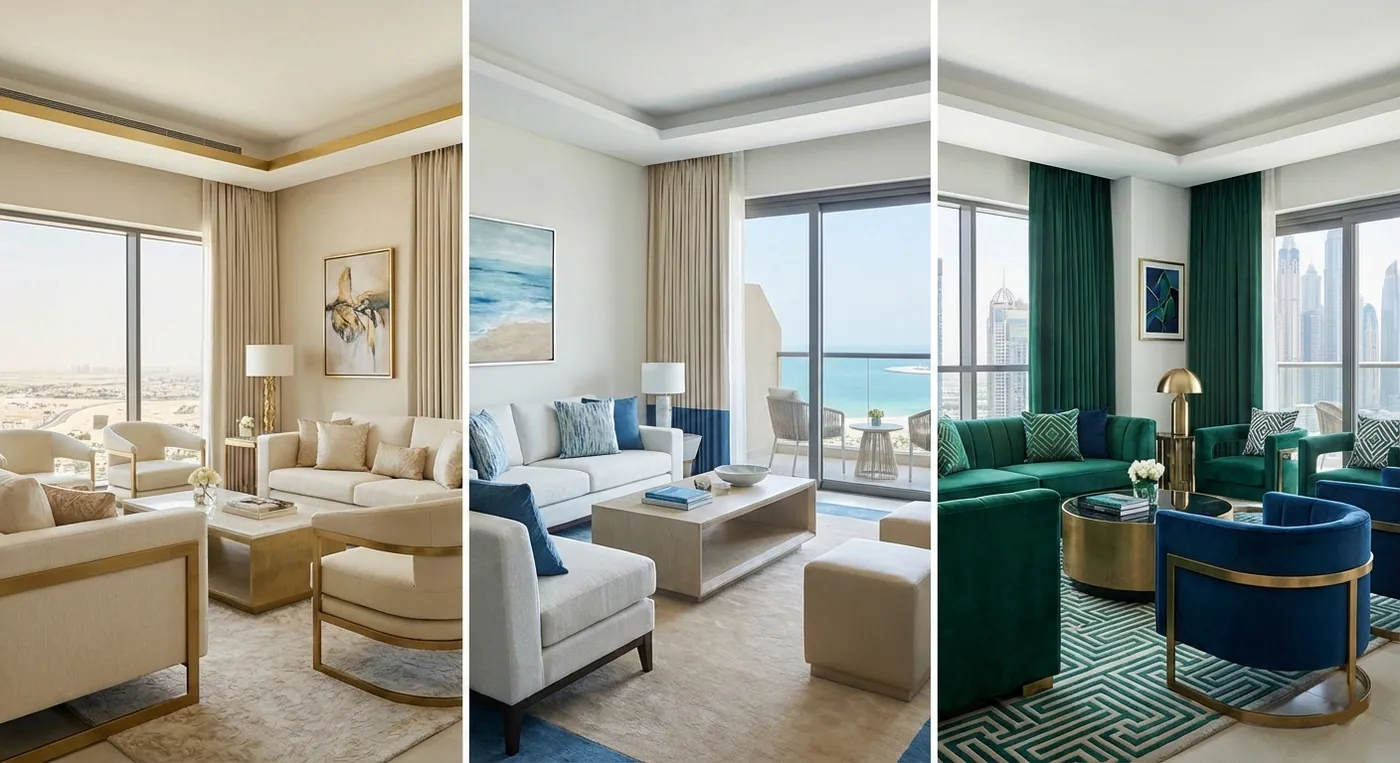
Rather than using plain white, the trend in the design world is now shifting to "Greige" (a mixture of grey and beige) and sandy colours. These are the colours of the desert and hence bring about the elegant look of the outdoor decor lighting inside.
Warm White: Great for walls so as to get the most natural light without the space becoming cold and uninviting.
Oatmeal and Bone: Perfect for giving sofas and rugs some character and life. Additionally to the above, terracotta either in small details such as the pillows or in bigger ones like the tiles helps connect the indoors with the natural landscape.
Dubai is a city that is known to be the epitome of wealth and extravagance. One of the ways to express this vibe is through successful colour schemes that have metallic elements as part of the composition. Some of the most frequently used metals are gold, brass, and copper. They can dramatically change the look of any space by making it feel more luxurious in an understated way.
The main thing is that metals should be used as a splash of colour rather than the star of the show. When metallic finishes are combined with matte textures, the resulting contrast is stunning. This method of decorating is typical of the upscale interiors, for example, in areas like Downtown Dubai or the Palm Jumeirah.
- Light Fixtures: A brushed gold chandelier can be a great decorative piece.
- Hardware: A simple swap of kitchen handles to brass ones can make a huge difference.
- Inlays: If you want to, you can have marble flooring with thin metallic strips to get a modern Middle East vibe.
Coastal Blues and Middle Eastern Gulf Teals
One of the most incredible things about living near the coast is that the sea is always there to give you ideas. Bedrooms and bathrooms are perfect places to incorporate cooling blues and teals. These colours help pupils to relax by giving them a psychological breather from the hot weather outside.
Light, soft aquamarine and dark, navy-blue are the two tones that architects often use when designing penthouses facing the Middle Eastern Gulf in Dubai. These colours produce the best effect when paired with a fresh white trim and a light wood floor.
- Sky Blue: Best for guest rooms where you want to create an atmosphere of tranquillity.
- Deep Teal: It is a perfect colour for velvet armchairs or feature walls to give a place an extra dimension.
- Mother of Pearl: Use shiny accessories to reflect the treasures of the sea. Modern Middle East Jewel Tones
Traditional Middle Eastern design is famous for its rich, saturated colours. In modern interior design Dubai, these jewel tones are used sparingly to create focal points. A couple of the most popular choices are emerald green, ruby red, and sapphire blue.
These colours are perfect for a dining room or a formal majlis area. They give the feeling of history and culture while still being fresh and stylish. If you want to keep it modern, mix these heavy colours with lots of neutral space to balance them out.
- Test under LED Lighting: In most residences of Dubai, evening times are illuminated with artificial light. Therefore, always test paint swatches not only under natural daylight but also under your specific indoor bulbs.
- Consider the Floor: Most of the properties in Dubai have marble or tile floors already installed. Make sure your wall colours go well with the undertones of such flooring.
- Use the 60-30-10 Rule: Use 60% of a major colour (neutrals), 30% of a minor colour (blues or wood tones), and 10% of an accent colour (gold or jewel tones).
Summary
Designing with colours the right way in Dubai should be a mix of both the desire for a beautiful home and the practicality of living in such a city. If you mix sandy, desert-beige type neutrals, cool ocean blues and some selective use of shades of metals, you can come up with a well-balanced home.
A right colour palette does more than simply beautify your space; it contributes to your mental health and the realisation of your home as a personal retreat. Whether you are renovating a villa or styling a new apartment, these colour combinations offer a proven way to achieve a professional look.
Common questions
Why do neutral palettes work so well in Dubai?+
Because they hold up under the light. Strong daylight flattens and bleaches saturated colour, while sand, stone and plaster tones read as intended across the day. They also sit comfortably with the materials most often used here, and they date more slowly than a strong colour decision.
How do you add colour without losing the calm?+
Through depth rather than brightness. Coastal blues, Gulf teals and muted greens read as an extension of a neutral scheme rather than a departure from it. Keeping the strong colour in things that can be changed — textiles, art, planting — also means the decision is reversible.
This is part of our residential interior design. One team designs and builds it, end to end.
Raj Khaneja — Founder & CEO
Raj founded Rectangle Interiors in 1999 and was named Designer of the Year by Dubai Municipality. He and the team have delivered 1,500+ interiors across Dubai. More about the team →